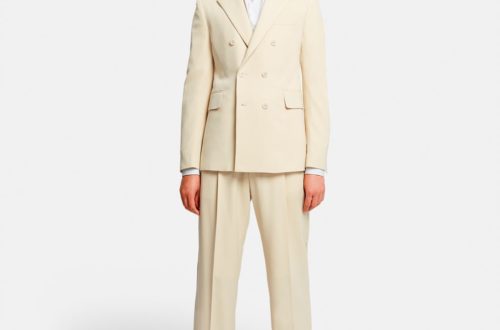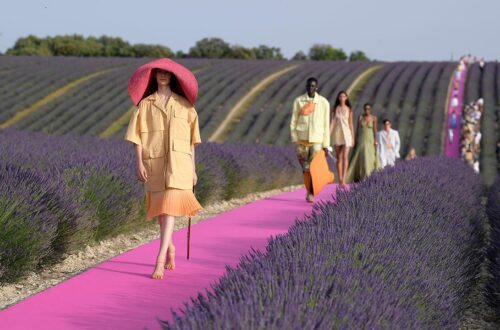


Dolce & Gabbana Alta Sartoria SS26, Ponte Sant’Angelo, Rome (Image Courtesy of Dolce & Gabbana)
During Dolce & Gabbana’s Alta Sartoria SS26 show on the Ponte Sant’Angelo in Rome, the usual front-row crowd of Kardashians, pop stars, and influencers was replaced by dozens of cardinals in scarlet robes. The scene—charged with religious iconography, power, and symbolism—was striking yet unsurprising for the Italian brand, whose intricate relation with Catholicism has always been evident. Although religion has long influenced fashion, bringing the Church onto the runway was a limit no other brand had ever crossed.
This spectacle raised many questions. As society seemingly rejects religion, why can’t fashion do the same? From Christian Lacroix to Jean Paul Gaultier, religion has always been a prime subject of historic collections. Here, Dolce & Gabbana continues the tradition. But what does this relationship between religion and fashion, in its different forms, reveal about our society?
History and Influence
When examining spirituality in fashion, one notices a striking disproportion in the representation of different faiths. Christianity, particularly Catholicism, surpasses by far the coverage of Islam, and Judaism is almost absent from the shows. This imbalance reflects not prejudice but the geographical and cultural contexts of the four main fashion weeks, held in cities where Catholicism is deeply rooted. This revelation led me to wonder why context plays such a structural role in fashion, and the answer lies in the two processes of religion’s introduction in collections. Fashion’s appropriation of religion goes beyond the mere use of symbols; it represents a long and seamless integration into the creative process, with the designer’s faith leaving a discrete influence on fashion and, by extension, on culture.


Sorelle Fontana, 1956 (Image Courtesy of Sorelle Fontana Archives) Armani retrospective, Pinacoteca di Brera (Image Courtesy of Armani/Silos) – Coco Chanel, 1926 (Image Courtesy of Chanel)
One of the first to embody this connection was Coco Chanel, who made history in 1926 with her fashion staple: the little black dress. The so-called ‘Chanel’s Ford,’ in reference to the Model T, made black chic, transforming a colour once reserved for mourning into a symbol of elegance. Yet, this silhouette was inspired by Coco’s own education in a convent and religious school. The simplicity of the nun’s clothes, echoing what we now call modest dressing, profoundly influenced her style. Without the nuns, this fashion staple might have never found its place in our closets.
A few decades later, another design that shattered the world was the Sorelle Fontana’s prettino dress, inspired by ecclesiastical wear from their Fall 1956 ‘Cardinal Wear’ collection. Although controversial at the time, this piece inspired many designers including Oscar De La Renta for his SS16 ready-to-wear collection where the reference to the clerical attire is subtle, but still present. Between these two historic dresses, one is merely inspired by the Church and the other is a direct copy of it, not without a hint of critique (‘prettino’ meaning ‘little priest’).
Recently, this relationship between fashion and religion has been observed at the Pinacoteca di Brera, where Armani’s designs are displayed alongside religious art. There, the clothes are in dialogue with the religious paintings; the richly ornate works mirror the fine and detailed embroideries characteristic of Armani’s designs. Once again, the presence of religion in fashion is undeniable, but it does shift between subtle inspiration and direct imitation.
Culture and the Cross
The two categories, inspiration and imitation, are not opposed, but rather complementary. They both operate within the wider realm of culture. Religion is not a source of inspiration like the others such as social change, current events, or travel. For those, the opposition between influence and copy is often analysed (think about the cultural appropriation debate). Unlike most forms of influence, religion and culture are profoundly intertwined, and this complexity explains both the variety of forms of religious references as well as its manipulation by brands.


Vogue, November 1988 (Image Courtesy of Vogue) – Léna Mahfouf at the Cannes Festival, 2025 (Image Courtesy of Getty Images)
Pop culture is saturated with religious symbols. A prime example is the Vogue cover of November 1988. Anna Wintour decided to portray Michaela Bercu wearing a Christian Lacroix top adorned with a jeweled cross. The cover was praised for its genius, but never interpreted as a Christian statement. Since this cross is so deeply rooted in the cultural background, it functions less as a religious symbol than as a cultural one. This is the perfect illustration of religion feeding a culture, and so, inspiring fashion.
But would this cover have had the same reaction in Vogue Arabia? Would people in Arab countries have seen more blatantly the religion association? Yes, because the sensitivity of religious inspiration is culturally situated. For example, during the 2025 Cannes festival, a dress by The Row sparked intense debate in France. Worn by influencer Léna Mahfouf, it was inspired by the modest silhouettes of Arab abayas. Although the design is very classic, it raised opposition because her critics weren’t acquainted with this inspiration, claiming it was promoting a religion. In the same way, as an atheist who hasn’t lived in the West, I would attach to the Vogue cross a more religious connotation than if I had been immersed in a culture rooted in Christianity. Hence, there is a form of hypocrisy to state that a dress promotes a religion. It is simple bias by our cultures, driven by religion.
This logic explains why Dolce & Gabbana is not considered as solely a religious brand. Its inspiration from Catholic imagery is in fact drawn from Italian culture, shaped by religion, its associated values, the Rococo aesthetic of Italian cities, and the simplicity and traditionalism of its countryside. Fashion rarely connects to religion directly; rather, it engages with cultures shaped by it. Dolce & Gabbana’s connection to Catholicism runs deeper than aesthetic; their marketing campaigns often promote traditional values, particularly the beauty of family, motherhood, and generational legacy. Similarly, when luxury houses seek to connect with the Arab culture to sell more in this growing market, they more than often do so through religion. For instance, the Dolce & Gabbana collection for Arab women with modest clothing was heavily promoted during the sacred period of Ramadan.
The ‘Religious Spill-over‘
Watching the Dolce & Gabbana’s Alta Sartoria SS26 collection, I was left in awe with a profound admiration that is unique to the brand and to the religious presence it embodies. Yet this connection cannot be explained by cultural proximity since I am neither Italian nor Christian. What does religion bring to a show beyond cultural familiarity? The answer lies in what I call the religious spill-over: the broader aims and emotional reach of religion itself.

Dolce & Gabbana Alta Sartoria SS26, Ponte Sant’Angelo, Rome (Image Courtesy of Dolce & Gabbana)
Regardless of context, certain attributes of religion are inherently artistic and easily translatable into fashion, which explains the art’s particular affinity with the sacred. Religion aspires to transcend. It is grounded in materiality, but desires to move beyond it. It conveys timelessness, and its rituals lend form, rhythm, and authority to any act of creation. Similarly, fashion transcends the mere utility of clothing to become an art. Though trends shift rapidly, the ultimate goal remains to make a lasting mark, to achieve a kind of timelessness, and the fashion show itself functions as a ritual that confers authority to garments, much like a Mass.
For this reason, even when Dolce & Gabbana’s work flirts with sensuality, it does so with the theatricality of a high Mass: intense, emotional, and imbued with reverence for something greater. Their collections move beyond trends, maintaining a consistent aesthetic without ever appearing outdated. This timeless vision is precisely what draws us in. In Alta Sartoria, the silhouettes are innovative. Sumptuous jewels, cross-encrusted blazers, draped garments are shown while staying simultaneously classical. Not classical in the sense of ‘Quiet Luxury,’ but rather classical in religion. The brand seems to operate in a different league from other major houses, grabbing a sense of religious eternity.
Fashion as Performance
Jean Paul Gaultier expressed this same connection explicitly in his Spring 2007 collection, which presented fashion as a form of religion. He called this duality ‘the worship of true beauty.’ Through Catholic symbols like the paintings and halos, and religious narratives with pierced hearts and jewel tears, he gave spiritual depth to couture. Thus, in their very essence, religion and fashion pursue a common goal. Both seek transcendence through form and ritual, and the fashion show itself even mirrors the structure of a High Mass.
In Alta Sartoria 26, the choice of the Sant’Angelo bridge is an even smarter move to connect the mausoleum, place of death and mourning, to the lively city of Rome. It becomes something greater than a bridge; it is a tangible link between life and death. Once outside the runway, stripped of that sacred framework, religious references in fashion take on another meaning. They then began to oscillat ebetween offense and reverence, faith and spectacle.


Rosalía for LUX, 2022 (Image Courtesy of Columbia Records) – Met Gala ‘Heavenly Bodies,’ 2018 (Image Courtesy of Vogue) – Rihanna for Interview, 2024 (Image Courtesy of Interview Magazine)
Jean Paul Gaultier celebrated religion on the runway in 2007, mesmerizing us with his theatrical homage. Later, Madonna wore one of his designs for the Met Gala, but the same inspiration created a very different meaning. From the runway to the paparazzi, context changes everything, and with it, the power of the clothes themselves. The theme of the 2018 Met Gala, ‘Heavenly Bodies: Fashion and the Catholic Imagination,’ once again highlighted the overrepresentation of Catholic aesthetics in Western fashion. Although the exhibition inside the Met perfectly illustrated the dialogue between religion, art, and culture, as well as the idea of a ‘religious spill-over,’ the red-carpet interpretations largely flattened these complexities. Many celebrities’ outfits reduced the sacred aesthetic to extravagant gowns and caricatural headpieces. At best, a few sought to challenge religious imagery by confronting the values it conveys. Madonna, for instance, has long used Catholic aesthetics throughout her career while criticizing the Church for its stance on women’s rights.
This represents one of the last uses of religion in fashion: a statement. Many celebrities deliberately play with the contrast between their identity and the associated values of religious wear. Madonna exemplifies this tension, but so does Rosalía, who revisited religious imagery for her album LUX. She used a nun-inspired dress, as well as Alexander McQueen Spring 2003 rosary sandals. Fashion democratized these symbols on the runway, transforming them into bold statements.
Some might critique a sense of blasphemy in this use of Catholic aesthetics, as shown by the backlash Rihanna faced after her Interview magazine cover. Yet the true enemy of reverence is not offense, it is indifference. Rihanna’s work plays with these symbols, acknowledging the complexity of religion’s place in culture as a multifaceted whole, whereas the celebrities at the Met Gala merely flattened that relationship into a spectacle designed to attract paparazzi.
The Cardinals as Spectators
Finally, what does all this reveal about our society? Even though we are statistically more secular than ever, why do we remain fascinated, almost obsessed, with religion in fashion? In his ‘Religion in Culture: Religionism or Pragmatism?’ article, J. Wesley Robbins responds to this paradox. To believe that this obsession reflects a renewed sense of faith is to adopt a religionist view: the idea that religion lies at the center of culture, serving as a universal source of truth. At first glance, this could explain why religious references are so prevalent: people seem to long for a return to the sacred.
Yet, as Robbins develops, the true sign of a deeply secular culture is that it no longer seeks an ‘ultimate truth,’ but instead draws on multiple vocabularies depending on its needs. Religion, though a major influence on both culture and fashion, remains only that. It is an influence, not the foundation of our worldview. Designers such as Dolce & Gabbana and Jean Paul Gaultier, by appealing to religion’s authority and sense of transcendence, demonstrate that fashion can also lead us toward meaning or truth. Ultimately, the clearest evidence of secularization is not outrage over crosses on the runway, but rather that at Dolce & Gabbana’s show, the cardinals were mere spectators, seated around the garments, no longer at the center.

Dolce & Gabbana Alta Sartoria SS26, Ponte Sant’Angelo, Rome (Image Courtesy of Dolce & Gabbana)
Written by Louis Pringault
Sources:
https://www.vogue.com/article/met-gala-heavenly-bodies-ava-gardner-sorelle-fontana-pretino-dress
https://www.jstor.org/stable/20006301?read-now=1&seq=1#page_scan_tab_contents
https://www.vogue.com/article/orthodox-judaism-fashion-laws-of-modesty
https://www.vogue.com/slideshow/met-gala-red-carpet-live-celebrity-fashion
https://world.dolcegabbana.com/lifestyle/dolce-gabbana-abaya-collection