
The protests and demonstrations in European cities this October reaffirmed what we have seen on numerous occasions over the past decade: rebellion against the system is done with symbolism, and its target is often luxury. Yes, the vandalized stores of fashion maisons indeed embody capitalism; and, yes, high fashion items are indeed ungodly expensive, thus protestors get to diminish their symbolic value. Ultimately, we ought to be blunter: Fashion is Power. Not merely power to own, rather power to exhibit: messages, identifications, privilege, lack of privilege. In artistic and symbolic terms, the greatest power belongs to the one who creates. And from this perspective fashion is given a different role: out of all forms of artistic expression, it might be society’s most polished mirror. Polished to an unforgiving extent.
A team to know
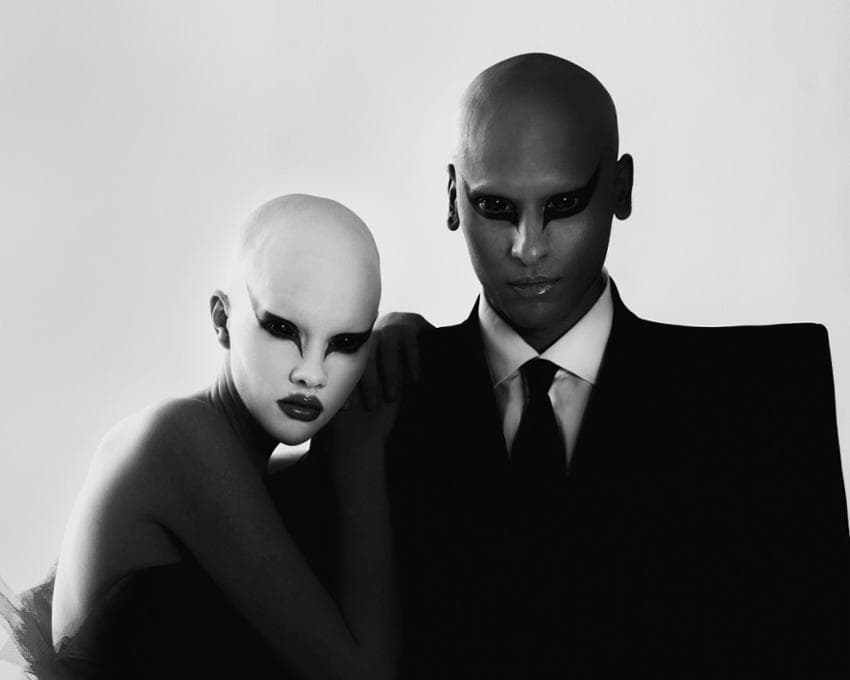
In 2014, the duo of Hannah Rose Dalton and Steven Raj Bhaskaran, both raised in Montreal, met at a fashion school and embarked soon after on a journey with a name that is bonkers enough to make anyone ask if they heard correctly. Matières Fécales gradually gained prominence, spending years in the spotlight of specialized fashion press. The mutual admiration with Rick Owens brought them further recognition within the industry.
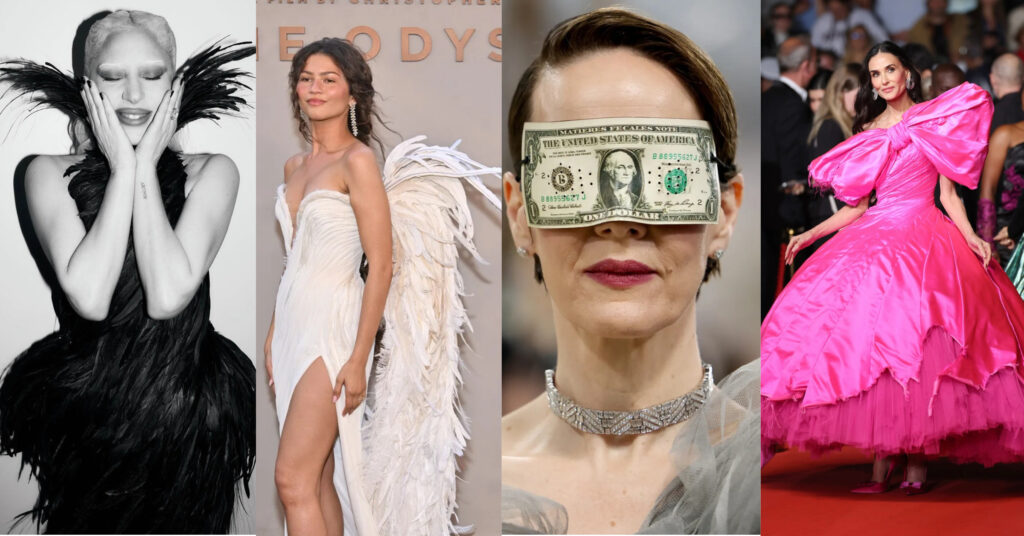
The two have been based in Paris from 2022 onwards and the name of this fashion house is now increasingly familiar beyond the avant-garde circles. The past twelve months, in particular, defined the brand’s future trajectory, especially on the red carpet: Gaga as Black Swan (Grammys 2026), Zendaya as an Angel (“The Odyssey” Premiere in NY), Demi Moore in Cannes. This new recognition pushed them under a new kind of scrutiny: that of mainstream public. Yet, in their brief brand history, what was most striking, as well as the subject matter of this article, is actually all about…math.
New “New Look”, or is it?
Matières Fécales’ “The One Percent” and “The Ninety-Nine Percent” shows were each grand spectacles of the two respective fashion weeks. The former, fall/winter 26, took place at the Palais Brongniart this March, crafted as a three-act story (“three tableaux of Power: of archetypes, of the community, of the future”). The latter opened this September’s PFW and took place at the Place de la République (in the designers’ words, “a sacred place for togetherness”, and “a place of revolution”). For both shows, they provided a short written description of the collections’ message, narrated by Bhaskaran; a candid and important read. For the “1%”, he gives the story of his humble beginnings in Montreal in “one of the poorest neighborhoods”. The collection is defined by coldness, lost glamour, lost purpose, yet an absurd endurance.
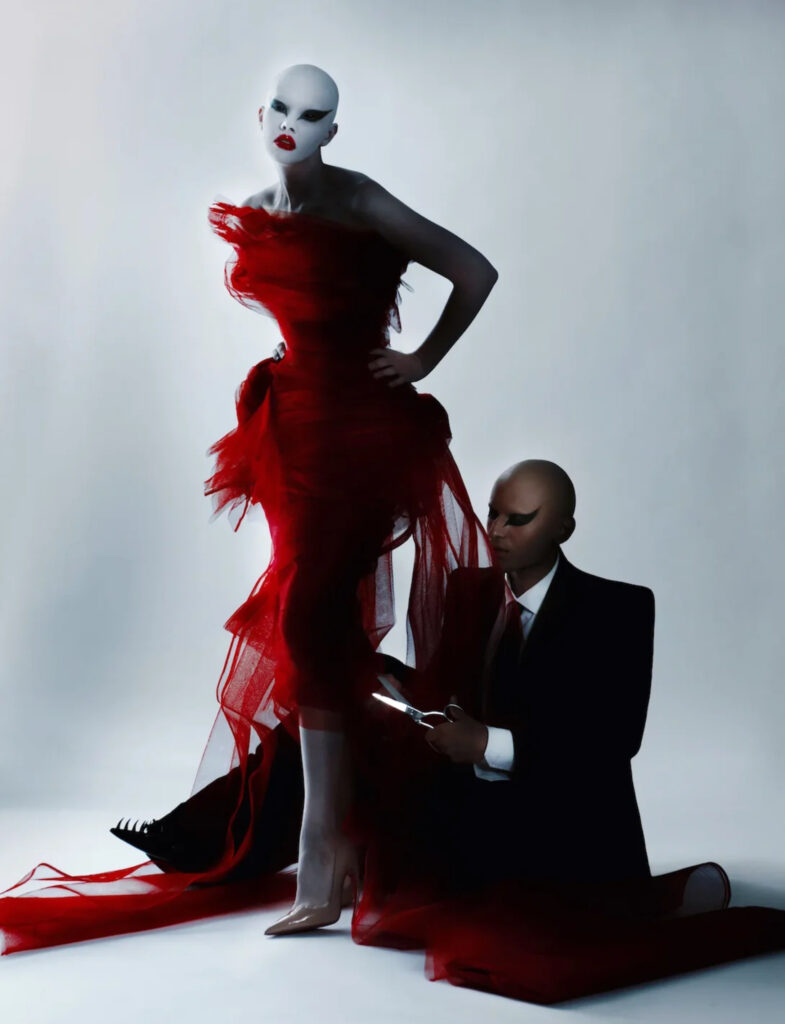
Bhaskaran goes on to make a strong statement, namely that they are fecalizing the New Look. Does this mean derogating? To an extent it does, but I am personally inclined to think of it more as a New “New Look”: the one belonging to the age we live in.
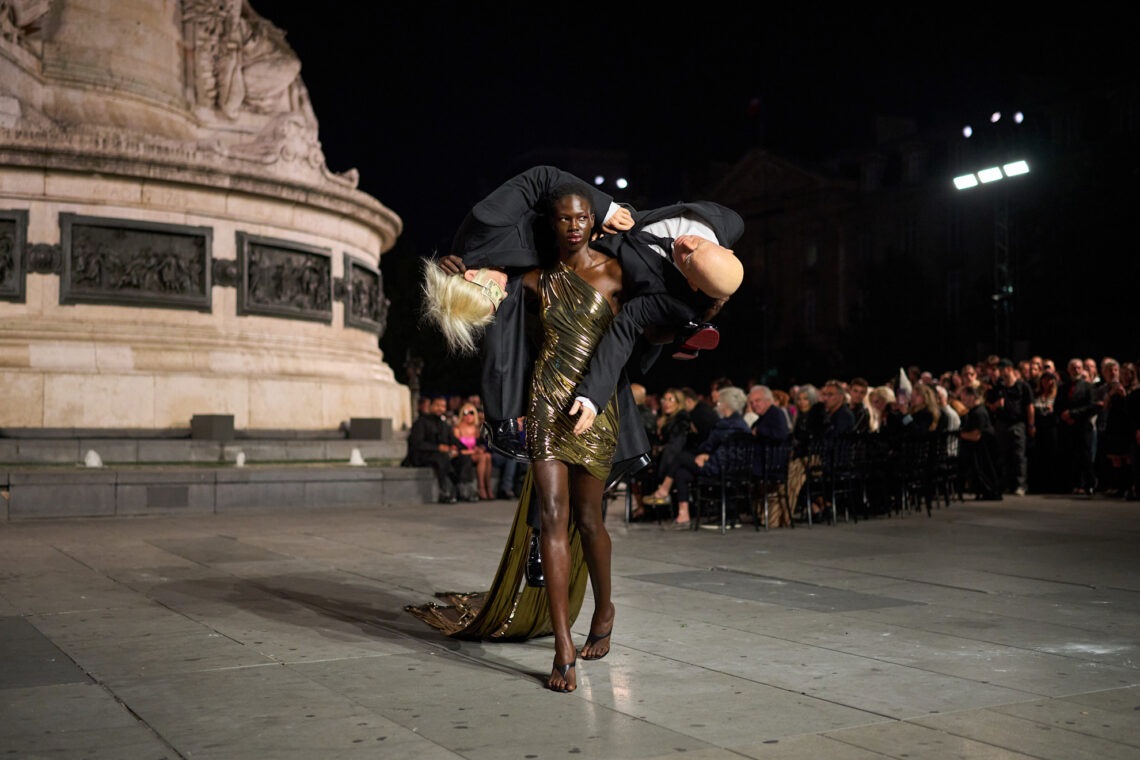
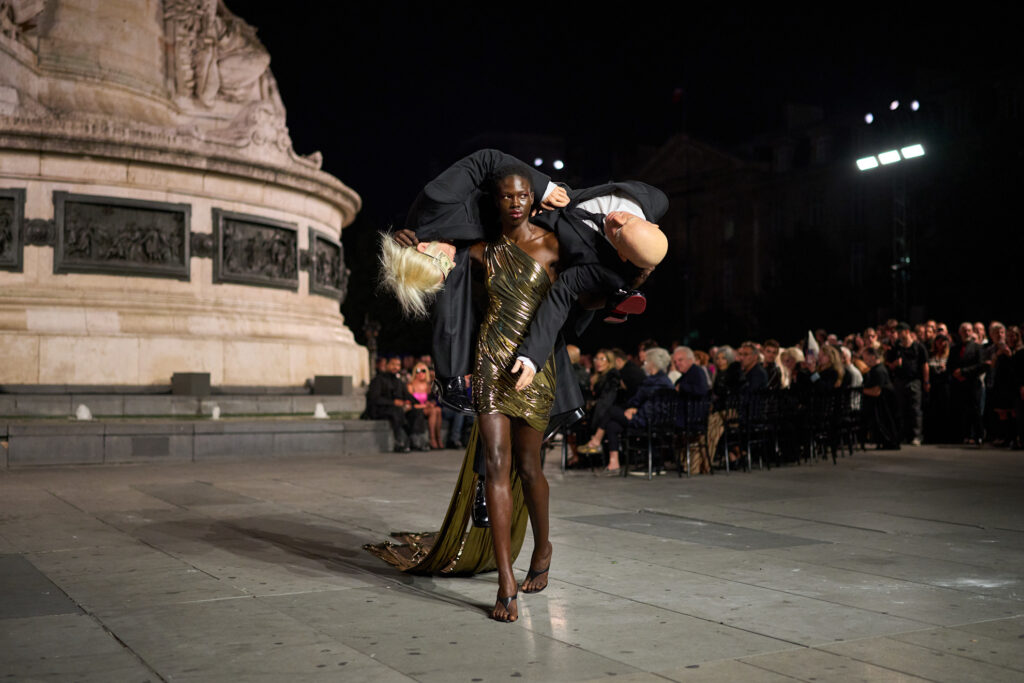
For the “99%”, we have 99 models of color and, again, three parts: Family (a commemoration of motherhood), Tribe and Gods; a tribute to the marginalized, yet to those who endure and pave their way. The show ended, expectedly so, on a high note: a woman of color carrying on her shoulders two mannequins of white men in suits. It makes one speechless.
You may say that the runway has on numerous occasions been a social commentary and this is nothing new, citing McQueen or Westwood as examples. What matters more to me is how rarely we see this, even in an age where we believe there is a far greater discussion of and action on all kinds of social issues. And that says a lot: maybe there is some self-censorship, or maybe fashion doesn’t need to take on such responsibility. Who knows. However, I think we can all agree on the fact that on most occasions when the catwalk has had this other function, it was indeed worth seeing.
Objection!
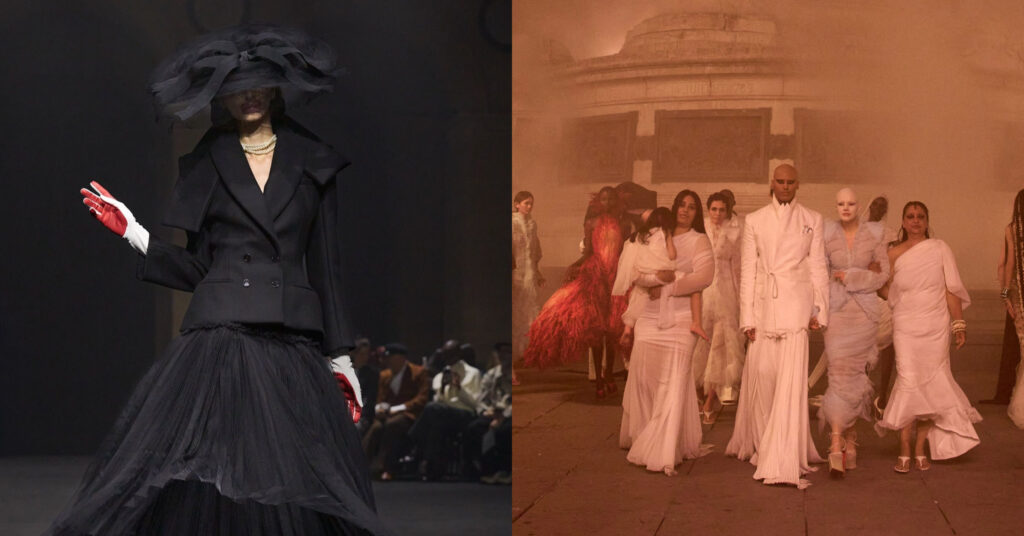
Aren’t Matières Fécales, nevertheless, making clothes exclusively for the One Percent, like every other high fashion brand? For sure, the clothes from the latest show are not affordable to those they honor. Then, are Bhaskaran and Dalton in a position to criticize the very world they are feeding? And who in this industry is in a position at all? If there is a straightforward answer to this, it is not so much about points of view and who has a right to share theirs; it is about an ability of embracing the Zeitgeist. But if we were to refer to that idea, we should note this is not only a matter of a certain problem being relevant. It is also about positioning oneself. Actively so. And this, at the end of the day, is a matter of choice. Status-quo is changed gradually, and the true change must come also from within. So criticism itself has to come from within this industry, along with self-realization. Why can’t they all criticize? The problem of the effectiveness of criticism is precisely its legitimacy.
This is not any brand, for example. It is made of and stands for the voices of “others”, outside the one percent, especially considering Bhaskaran’s upbringing, who cites it repeatedly as his muse. An outsider who gets to speak from the tribune of those whom he is critiquing. But to me most importantly, behind every piece you see Steven, you see Hannah, and all they stand for. In fact, they even model for their own runway, and do the models’ makeup. But bear in mind, legitimacy is constantly proven, not given. So, their position and the “right” to such position will only show with time.
Blurring the borders
Does 99 plus 1 equal unity, one hundred? As Bhaskaran says: “There is a part of the one percent that have access to tools of life that most of us don’t.” The equation probably can’t hold since it never has. If disparities, inequality and segregation cannot be overcome fully, though, progress can be seen in blurring the borders between one and ninety-nine. From this perspective fashion is not only a platform to speak (and this is a responsibility that all designers should remember); it is also an active participant in the clash. And the use of such “blurring” is precisely what Matières Fécales can be praised for; like Lee Alexander McQueen with his “Voss”, like Vivienne Westwood with her “Propaganda” (who famously said, “I use fashion just as an excuse to talk about politics”). In an interview cited below, Hannah said the two of them were initially “united by their hatred for this industry”. And indeed, an industry that has in its history (and still) been associated with cases of mistreatment, a bad work environment and lack of sustainable practices.
The case of Matières Fécales is worth observing, because you see the designers’ stance in a setting where one seldom has the audacity to challenge the very setting. When there is a message, sometimes implicit, sometimes shakingly explicit, fashion becomes once again a symbol: but not entirely that symbol which was being stolen by some of the demonstrators. The kind of symbol that is self-sufficient.
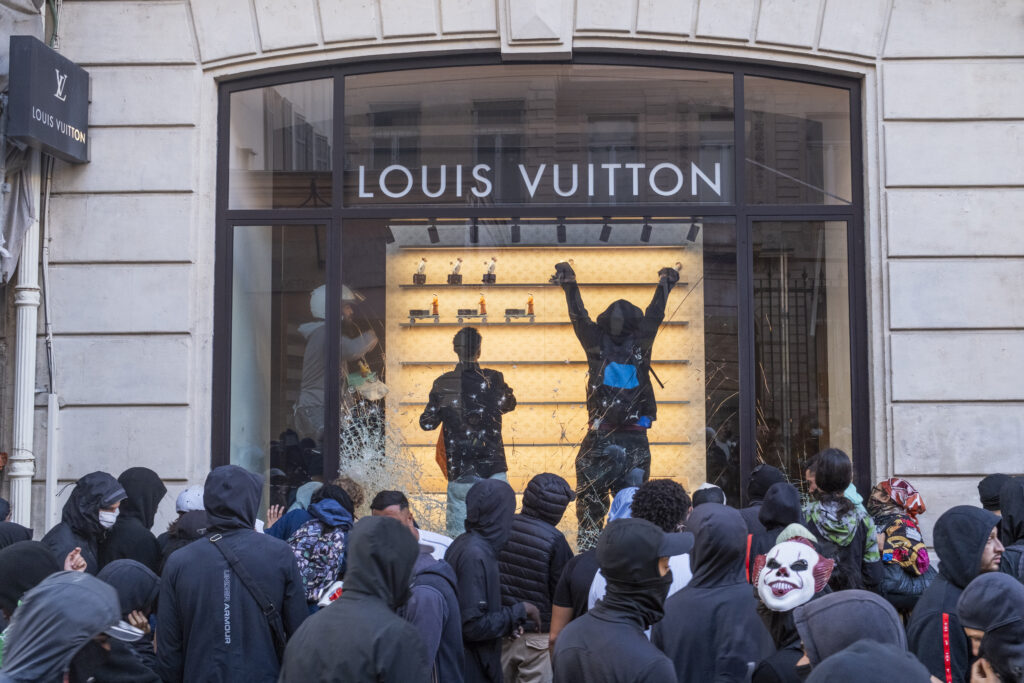
The protests may be subsiding, but the resentment of thousands remains. The very concept of power is to be questioned at all times; it affects everyone. Fashion has a peculiar relationship with it, and maybe that is why we find ourselves drawn to it: sometimes we hate it, but mostly weadore it. At the end of the day, fashion has always been a matter of relevance, of superficiality, of meaningfulness. And since all this goes hand in hand in this industry, it is up to creatives to approach the dynamics properly. And to approach it at all. This is how fashion transcends itself, everyone.
By Toma Nikolov
Sources:
https://youtu.be/tzcW2EXR6J8?si=XbhcBCdSCW4NgPMX (interview w/ Bliss Foster);
https://www.nytimes.com/2026/10/21/style/france-riots-luxury-dior-hermes.html ;
The descriptions of the shows provided by Matières Fécales in their YouTube channel (https://youtube.com/@matieresfecalesparis?si=jVSV8HAxeltWDaLH)