
Setting the Scene
During Milan Fashion Week, Vogue World was a spectacle that garnered tremendous discussion and media attention. However, one element of the show sparked particular controversy – the robots. Drawing audible “boos” at the BS4F Vogue World watch party and unimpressed expressions from Miuccia Prada and Alessandro Michele in the front row, the humanoids’ presence at the Galleria Vittorio Emanuele II was not exactly everyone’s cup of tea.

Many were put off by the featured robots because they felt it entirely undermined the event’s theme of Italian craftsmanship. It was a stark contrast against the backdrop of the centuries-old Galleria, and what was even more counterintuitive was the lack of clothing on the robots or any relation to it. Vogue tried to explain this choice as intentional, stating, “If their presence amid top models such as Alex Consani, Ruth Deng, and Yumi Nu seemed a little uncanny, that was entirely the point.” Vogue World Milan’s creative director explained why the robots were featured, saying, “The robots came into the conversation to represent this very moment that we’re living through, which is the beginning of robotics.” He further added, “It’s fun, because robots are fun. But it’s also terrifying and is meant to say, AI is not going away, and the robots are not going away.”

What Happens When the Robots Pay the Rent?
In opposition to this, critics of the choice have underlined that fashion is not inherently against technology and is definitely no stranger to innovation. Runways have integrated tech and robotics into shows for a long time, from Coperni to Alexander McQueen all the way back in 1999. The issue with Vogue World was more so the execution – the robots were interacting with neither the models nor the clothes. Not creating or wearing any garments, and not making meaningful statements about the interactions between humans and advancement. It is the way technological tools are utilized and the meanings created that have the potential to create an interesting show, which is what felt lacking to many in the appearance at Vogue World.
Various sources, like the Financial Times and NSS Magazine, were quick to observe that this year’s list of financial supporters for the event included companies like Meta and OpenAI. While many fashion companies face financial constraints, big tech executives are entering the field to grow their cultural capital and improve public image. As traditional publishing loses traction, events such as Vogue World can be vital to Condé Nast for publicity and serve as significant drivers of revenue. While this big tech and fashion partnership may thus make sense financially, the robots situation really raises questions about whether, along with sponsorships, companies like Condé Nast are also selling some of the values for which the industry stands.
Fighting AI with Pen and Paper
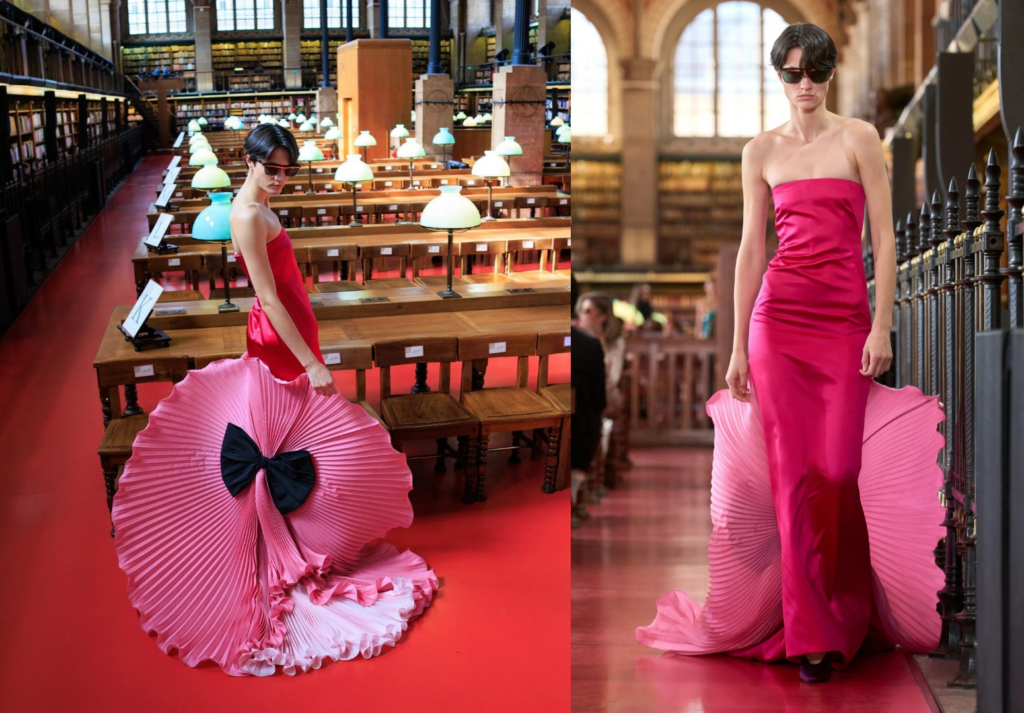
On the other hand, Valentino gave us a 180-degree opposite experience a week later at Paris Fashion Week. Invitations to the show included requests to bring a book, old or new, that would later be donated to local libraries. Additionally, the show took place at the Sainte-Geneviève Library, with models walking among rows filled with bookshelves. The setup reflected Alessandro Michele’s caution towards AI, and served as an ode to the human touch. Despite Valentino’s negative economic performance, Michele says he doesn’t want fashion to be solely about numbers and aims to stay true to his craft.
The collection was inspired by the term “Antibiblioteca” coined by Umberto Ecco to describe books left unread, which Michele linked to garments hanging idly in the back of one’s closet. In a preview, the creative director explained, “There is something that I like in the idea of having in my closet that beautiful piece that I’m probably never going to wear.”
Sustainable… Or Not So Much?
While this may appear as a more noble message compared to robots on the runway, does this approach also encourage overconsumption of both books and clothes? The romanticisation of unused purchases feeds into a culture run by consumerism, subtly encouraging viewers to purchase items even if they appear impractical and have a low likelihood of being worn. In a time when the brand’s finances aren’t thriving, this comparison between books and clothing pieces may serve as a clever marketing move, encouraging book purchase even if they’ll never be read, implying the same might be done for clothes. However, a book typically ranges between 10-20 euros, while a Valentino dress can cost thousands. It makes the garments sound like a “treat” to enjoy, linking to the Lipstick Index or newly introduced “little treat economy”. However, this mindset is not the most affordable for consumers at the moment, with even books seeming expensive to some. Even the closing of the library for the show raises some eyebrows as to the interrelation between private and public, and how the fashion industry interacts with spaces in a capitalist society. This reflects an economic reality in which luxury becomes less and less affordable as consumers are left with less disposable income, meanwhile fashion houses struggle to make a profit.
Reading this, you may feel a bit conflicted, asking, “Should we just cancel or boycott every fashion brand out there?” To this, I would reply, not necessarily. It is possible to find something to criticise about almost every brand; of course, some way more than others. At the end of the day, it appears that Vogue, Valentino, and we all seem to be in the same boat: barely making rent and fighting for attention in an oversaturated climate. To stay sane in this competitive climate, where ethics are for sale and cancel culture has lost all meaning, it is important that we keep in mind that any cultural event or object occurs in context, even if the context takes place in the present. We must thus focus our attention on being aware and critical, being able to see deeper into a campaign or show, the levers being used, and the impact conveyed – and use all of this to inform our decisions. Even if our economic prospects are bleak, we can’t let our critical thinking go down with them.
By Nastassia Tsialpuk
Sources:
Bain, M. (2026, September 25). Why the robots at Vogue World hit a nerve. The Business of Fashion. https://www.businessoffashion.com/briefings/technology/why-the-robots-at-vogue-world-hit-a-nerve/
Biondi, A. (2026, September 25). At Milan Fashion Week, Prada skirts the issue while Vogue World offers robots. Financial Times. FinancialTimes. https://www.ft.com/content/d5c23b98-cdef-4e86-94f2-e3ea41e5ee69
Cafolla, A., & Faccani, F. (2026, October 4). Plot twist! All the books guests brought to the valentino show. Vogue. https://www.vogue.com/article/valentino-spring-2027-show-guests-books
Colón, A. (2026, October 7). Alessandro Michele’s valentino storybook characters come to life in Paris. W Magazine. https://www.wmagazine.com/fashion/valentino-spring-2027-runway-photos
Diderich, J. (2026, October 4). Valentino spring 2027: Book smart. WWD. https://wwd.com/runway/spring-2027/paris/valentino/review/
Hannah Bertolino. (2026, October 4). The library is open at Valentino SS27. Dazed. https://www.dazeddigital.com/fashion/article/71116/1/the-library-is-open-at-valentino-ss27-paris-fashion-week
Ishmael, A. (2026, September 23). Safe to say the robots on the runway didn’t go over well. Cosmopolitan. https://www.cosmopolitan.com/style-beauty/fashion/a73852564/vogue-world-robots/
Salamone, L. (2026, September 24). Who wants a little AI propaganda? Nss Magazine. https://www.nssmag.com/en/fashion/46968/vogue-world-milano-robot-big-tech-openai-meta-fashion
Shane O’Neill. (2026, September 25). A stupid, ugly robot On The Runway At Vogue World: Milano. The Washington Post. https://www.washingtonpost.com/style/2026/09/25/stupid-ugly-robot-runway-vogue-world-milano/
Specter, E. (2026, September 23). The story behind the runway robots at Vogue World 2026: Milano. Vogue. https://www.vogue.com/article/the-story-behind-the-runway-robots-at-vogue-world-2026-milano