
Ciao. Probably the most famous Italian word there is, said with so much love and laughter. Hi,
hello, a really warm greeting, and also goodbye. It has a surprisingly humbling history, though.
According to Treccani, it comes from the Venetian s-ciao or s-ciavo, meaning “(I am) your slave.”
As a greeting, this expresses courtesy and deference, something we might understand as “at your service.” Over generations, it became the everyday greeting we say without thinking, a small anecdote I picked up during a Sales Management lecture at Bocconi.
That idea of being at someone’s service takes me back to the most basic moment in sales: simply entering a store. We hear phrases like “the customer is king,” but what does putting the customer at the centre actually look like in practice?
As a 22-year-old shopper, whether in a luxury boutique or a department store, I see a visit as an experience, one that begins the moment I walk through the door. As an international student, I also notice how differently stores and cities handle that first moment. Usually, I want to look around, understand the collection and decide what interests me before starting a conversation.
A welcome matters, but so does the freedom to browse. I often feel overwhelmed when several members of staff approach me shortly after I enter, a feeling shared with the friends my age.
An attentive advisor can make an unfamiliar space feel comfortable, while excessive attention can make the same space feel intimidating. The opposite can be just as uncomfortable. A dismissive response, an unexplained wait, a rude doorman or an advisor who seems to judge your spending power before hearing what you want can change the entire visit.
These moments raise two questions for luxury businesses: what does it take to get this right, and what does it cost a brand when it goes wrong?

The scale of it
Studying luxury as a business, we learn how its functions connect. Buying and merchandising shape what is available, marketing builds desire, and finance supports the operation. Yet when someone walks into a boutique, all that preparation meets something much less predictable: an interaction between two people.
Those are the “last ten feet” I keep thinking about: the distance between a customer, an advisor and the final transaction, where the work behind the brand becomes less automated and a personal and human experience. It is quite astonishing to think about how much of the final transaction come down to one conversation with one person.
The scale in this case makes this even more interesting. Bain & Company and Altagamma put
worldwide luxury spending, including goods and experiences, at €1.443 trillion in 2025. It matters even more because the money is concentrated. Bain’s analysis of 2024 found that very important clients, or VICs, represented just over 2% of customers but accounted for 45% of global luxury purchases, up from 35% in 2021. That is a huge share resting on a small group, thus keeping those relationships clearly carries a huge commercial weight.
Of course, it is not that simple. That conversation may follow an elaborate customer journey,
beginning with discovery through websites, social media and, increasingly, AI. Bain’s June 2026 research reported that approximately half of luxury consumers already used AI during their buying journey. This reflects an immense change in how people discover and evaluate products, and where they look for advice they trust.
Customers might arrive having researched and compared a product extensively, ready to purchase.
Or they might simply walk in to browse and discover. The advisor here has to understand which conversation they are entering: completing a purchase, introducing someone to the brand for the first time, or helping them explore without an immediate decision.
The machinery behind the curtain
Brands know this, and they invest in it. From Louis Vuitton to Prada, Bottega and Dior, they all
have CRM and client-recruitment and development teams. Their job is to build long-lasting
relationships, hit appointment targets, run outreach, collect customer data and use digital tools.
Even the systems behind large conglomerates are often connected. Bottega Veneta’s privacy policy, for example, describes other Kering companies processing information on its behalf, subject to confidentiality and contractual restrictions. That does not mean customer profiles are freely exchanged between houses, but it gives some sense of the infrastructure supporting the interaction.
There is so much theatre behind the scenes to support the theatre performed in store. This is where the human side of luxury becomes a business question.
How do you make someone feel welcome without making them feel watched? How do you recognise an opportunity without making every interaction feel like an attempt to sell?
And at what point does a relationship with an advisor start feeling overly commercial?
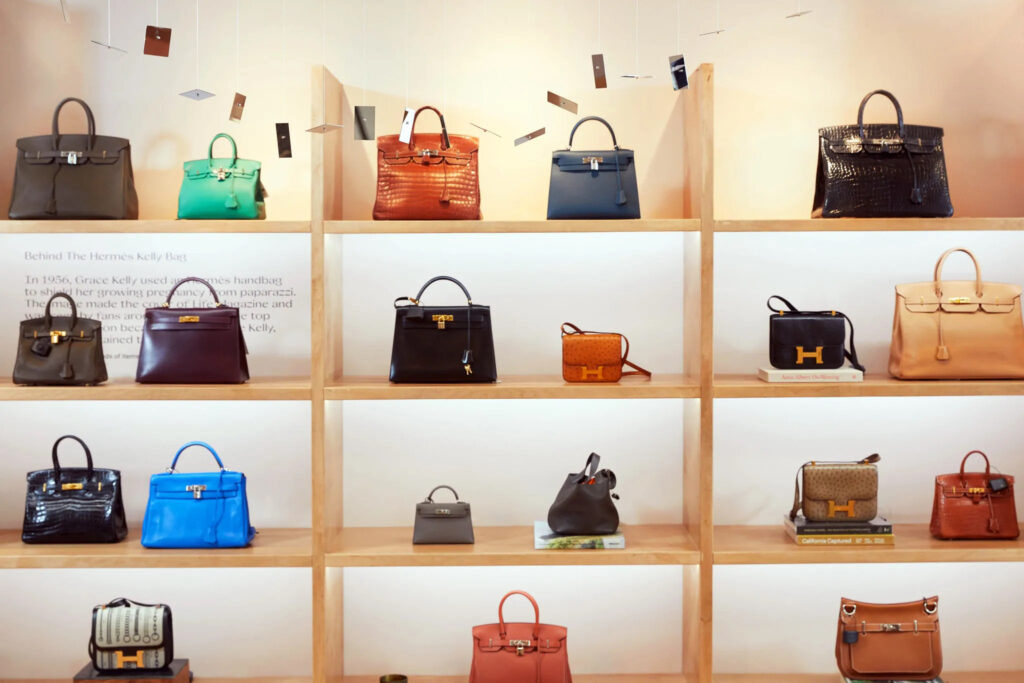
The much-discussed process of buying a Birkin comes to mind. A 2024 Guardian report described shoppers discussing $20,000–$30,000 in other purchases while seeking access to a Birkin. For me, this raises a bigger question about exclusivity. Is the attraction really the product? Or rather the relationship with the advisor, or the recognition of being offered something others cannot easily get? A private-event invitation can feel personally meaningful and also become something to display in your social circle? Clienteling operates within both possibilities.
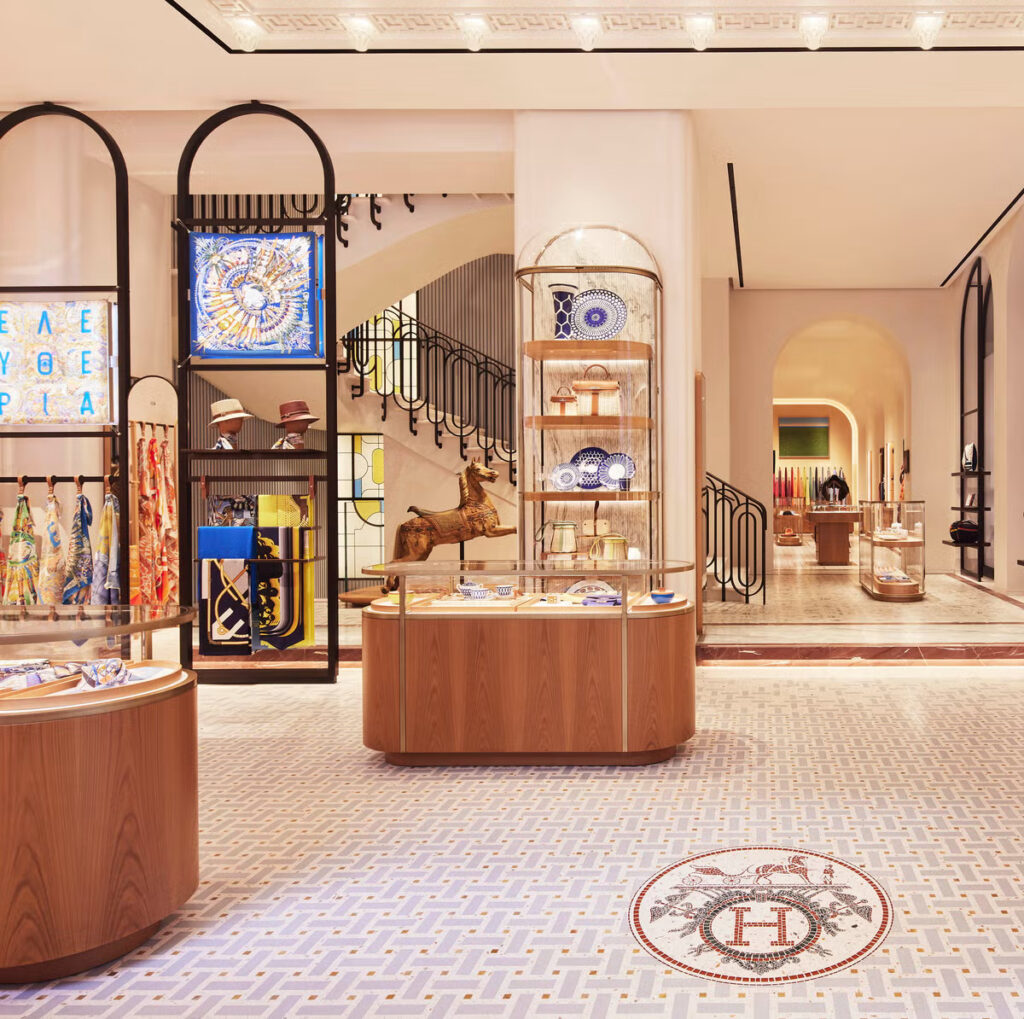
Moving to the consumer’s point of view, you are merely walking into a store. But it is fascinating to think how many functions come together to make that visit feel effortless, almost like a theatre performance, with even the smallest details thought through. An advisor might ask where you went on holiday or how your son’s theatre performance went. What feels like a spontaneous conversation can also be part of a carefully maintained relationship, where details from previous visits help shape the next one. Luxury clients are all over the globe and travelling constantly, so the aim is a similar experience wherever they walk in. It is not just one store, but a seamless experience in any store you enter, one that makes you feel at home in a foreign land.
What reviews tell us
Another interesting place to look is boutique reviews. They stand apart from a brand’s social media and website, and they show how a place was actually experienced.
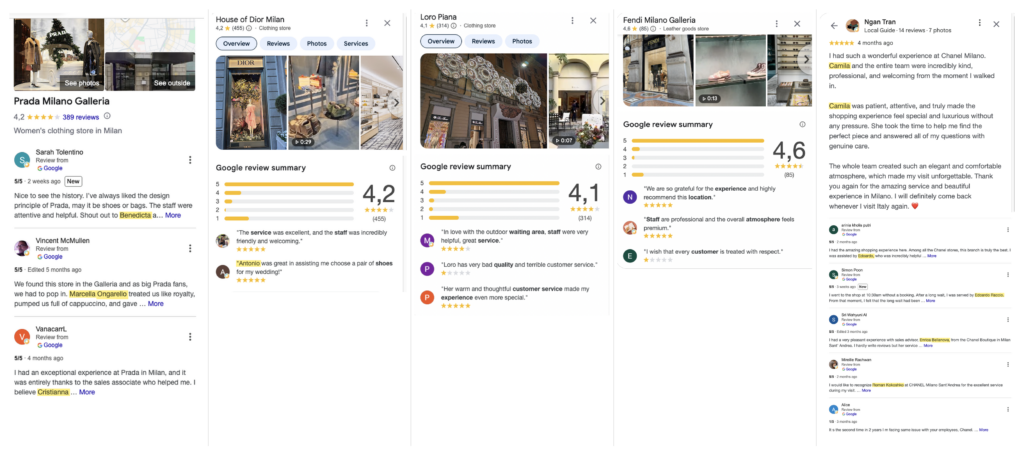
A small case of google reviews for Cartier Brisbane, showcase a strong contrast between five-star experiences and accounts of poor service. These accounts cannot establish a store’s overall service quality, but they show how differently individuals can experience the same location.
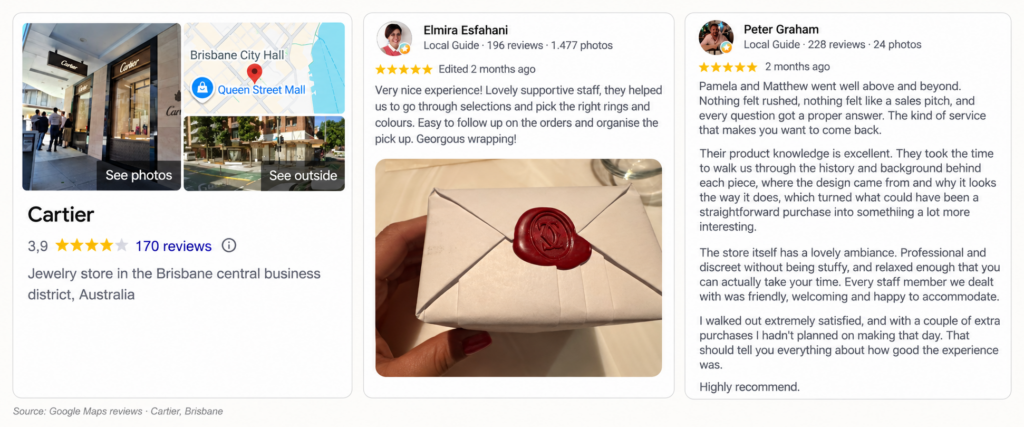
From analysing different stores’ reviews across different locations, I find the variance striking. A single store can have anywhere from around 100 reviews to around 1,500. The patterns inside them are consistent, though. The positive reviews in several cases name a sales representative. They praise the person, the atmosphere created by the staff, someone who listened, helped or made the visit special. It makes me wonder how simple kindness and humanity can establish loyalty, something that brands invest so much in creating. To me, that uncovers a deeper story.
Something else that is really striking to me is the decision to write a review at all. Among my own social circle and network, I rarely notice a post or discussion about an ordinary shopping trip. It takes an extreme situation- an exceptionally good interaction or a really poor one, to make someone say anything. Someone who goes online to give a particular salesperson five stars, and names them, clearly felt something. The same goes for someone who sat down to describe a bad experience.
Both ends of the spectrum can reveal what stayed with them.
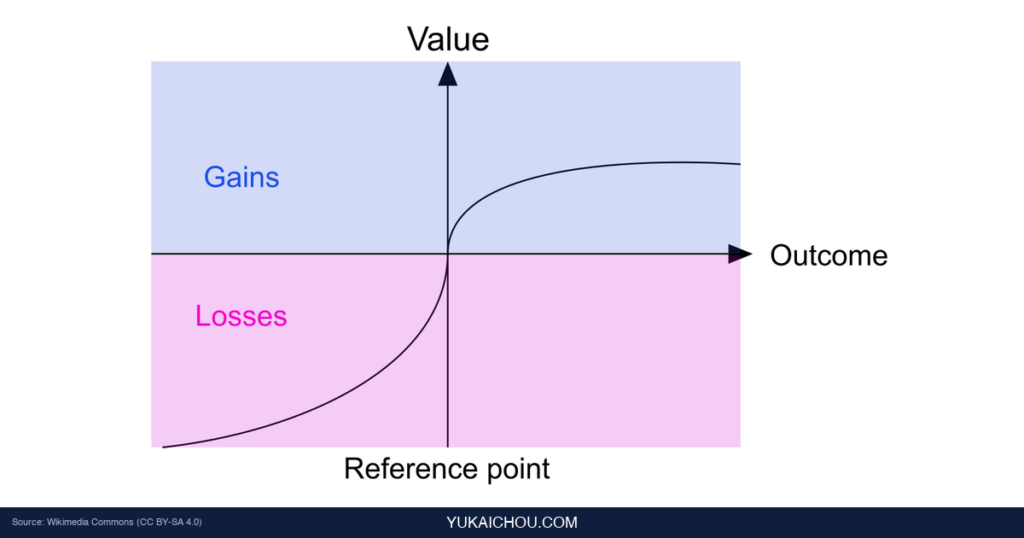
From a marketing point of view, the concept of prospect theory can further explain this and it’s
relevance for brands. Humans tend to be loss averse: a loss hurts more than a gain of the same size feels good. It makes me think that a negative review might weigh on the next shopper more than an equally strong positive one. A bad review probably hits harder, in case of a detailed, well-written account of what went wrong in comparison to a praise.
It is also interesting to see how differently brands react to these reviews. Most don’t reply at all, and the comments just sit there on the platform. Cartier and Brunello Cucinelli in my observation, replies to positive and negative reviews alike and tries to help customers with their grievances, even when things have gone badly. From a brand’s point of view, I find that quite accountable.
Another observation is how many people my age research a place before visiting. Among my
friends, this is common even for something as simple as choosing a restaurant. It makes sense when you are spending money and time on a meal you want to enjoy. It makes me wonder how often
people check boutique reviews before choosing where to buy a bag and have their luxury
experience. How much weight do brands give this, alongside their focus on social media?
From the above accounts, it is clear that the product brought customers to the store, but the
interaction was often what they chose to write about afterwards. That is what makes me lookbeyond the star rating and turn to longer discussions to understand what happened.
The Reddit Jungle
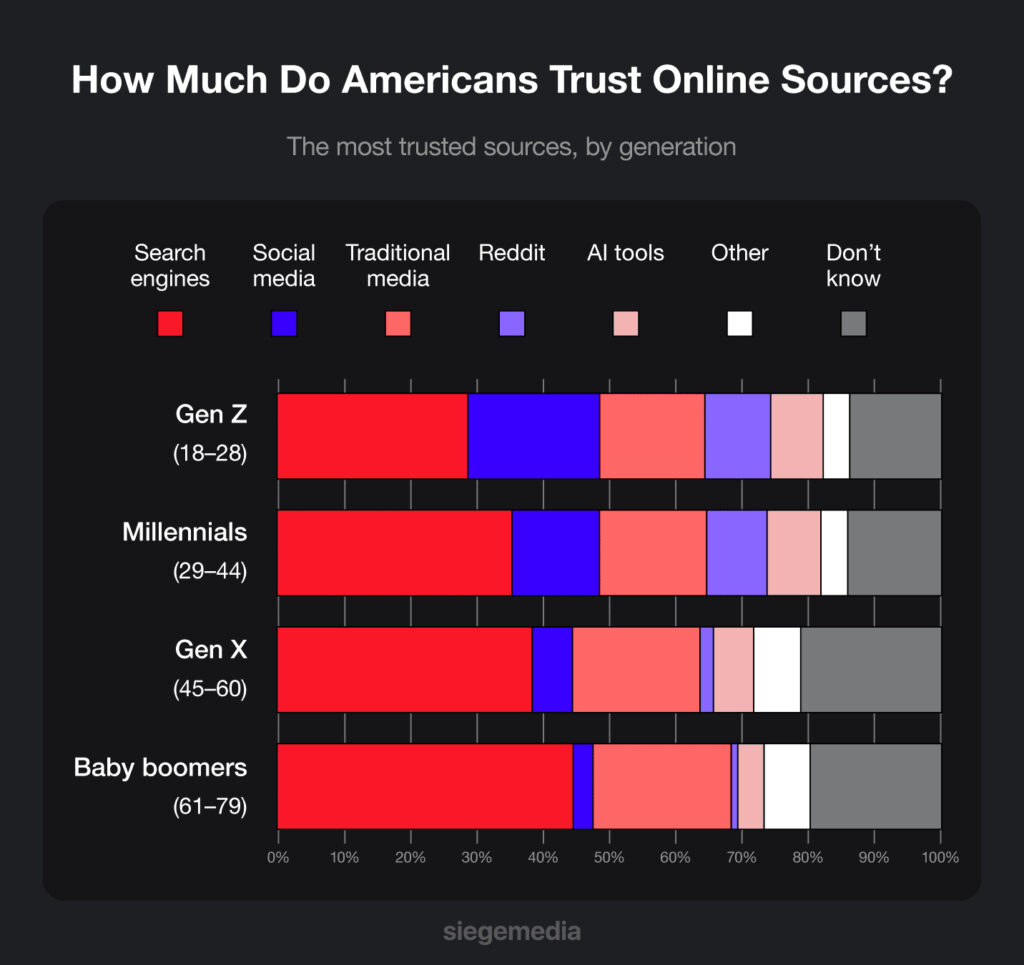
From a Gen Z perspective, Reddit is another place we go. Siege Media’s 2026 Trust Report, a
survey of more than 2,000 US adults, found that almost one in five (18%) use Reddit to find
information or answers a few times a week. We use it for detailed experiences, random questions, and to see whether someone has already had the same doubt. Its distance from polished brand communication is a big part of the appeal, and my generation seems to feel it most. In the same survey, 58% of Gen Z trusted the Reddit results they see in search at least somewhat, against 40% of US adults overall. siegemedia.com
That comes with its own complications now, though. Through different friend groups my age, I’ve heard of several people with side hustles running Reddit
marketing agencies. As I understand it, the work is largely automated, with people around the globe writing reviews for the brands that hired them. The commercial activity behind these conversations feels quite questionable.
Reporting has documented the same thing: brands and agencies plant promotional posts and comments hoping chatbots like ChatGPT and Gemini will later surface them as genuine recommendations. Reddit’s partnership with OpenAI explicitly enabled access to its content for use in ChatGPT and other products. The opinions we consult can therefore influence us directly and through an AI answer, which makes their independence harder to judge. digitaltrends
This whole concept feels like a complex jungle, adding another layer to everything happening
behind the scenes. But if reviews and Reddit can be gamed, the in-store interaction is the one thing that can’t be.

Is rudeness a strategy?
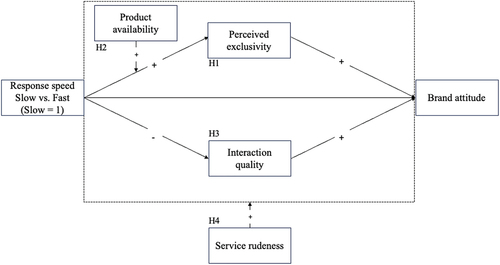
Back to what those forums say about the boutique itself. Reading customer accounts across the big Maisons, I was struck by how similar some complaints were: being judged on appearance, waiting without explanation, receiving dismissive responses, or never hearing back after a promised followup. That brings up an uncomfortable question: is rudeness a strategy?
A 2014 study found that rejection could increase desire and willingness to pay under specific
conditions, including when shoppers strongly associated an aspirational brand with their ideal
selves, and only at the very top tier of brands. It did not establish that rudeness creates lasting
loyalty. One former associate described a team leader sorting customers into types the moment they walked in.
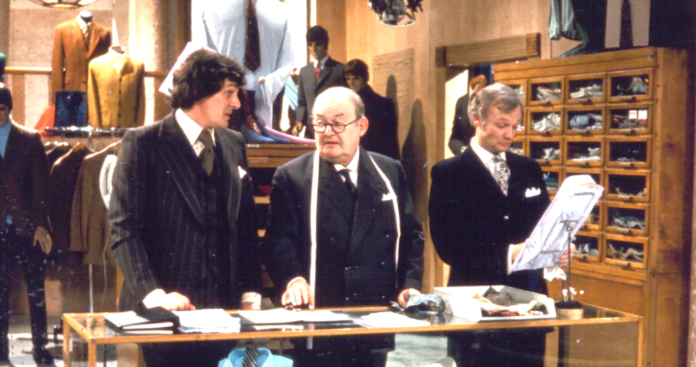
Maybe that approach worked back in the day, when making someone feel unworthy was part of the game. Honestly, I don’t think it holds anymore. Customers can’t tell strategy from indifference, and nobody can know from a first glance whether someone will buy. That sorting is exactly what produces the “judged by what I’m wearing” feeling. Times are changing, and I think kindness has become the far smarter strategy.
Loyalty belongs to the advisor
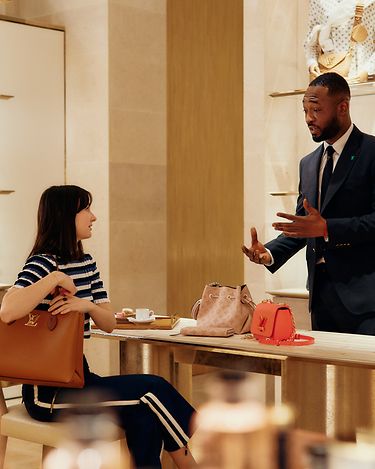
In many cases, clients are loyal to their client advisors, and losing a particular advisor can be a real problem for a brand. I wondered whether advisors take their clients with them when they change jobs. It seems they do.
Altagamma’s 2024 research found that around 70% of very important clients say they have a trusted advisor, and about 70% would be willing to switch brands if that advisor moved to a competitor. When an advisor leaves, they take years of preferences and trust, much of which exists in no official system. So the way brands shuffle advisors between stores is a commercial decision as well as an HR one.
Their influence also continues when someone leaves without buying. The experience may decide whether that person returns, recommends the boutique or feels comfortable asking another question.
That makes me recall a story from one of our classes. An executive from Cartier shared a personal anecdote about entering a luxury store in China and being welcomed with another brand’s name after employees had moved between brands. He just looked at the greeter, wondering what was going on. As a classroom anecdote, it shows how quickly a small mistake can break an atmosphere built on precision and immersion. It also shows how hard it is to expect people to perform that atmosphere flawlessly.
Back to the people
Brands spend enormous amounts on retail training, on clienteling and on events that complement it.
They give advisors the tools, the equipment and the knowledge of the brand and its universe. But at the end of the day, selling is a people skill. It’s business 101. It comes down to persuading your client, having a smile on your face and genuinely being kind. And we have to remember that everyone is human, and sometimes people make mistakes. What fascinates me is how brands handle that, every day.
So what happens in that final interaction, what it takes to do it well, and what it costs a brand when it goes wrong are the questions I keep coming back to. Training can’t fully control kindness, judgement or someone’s bad day. The right response is humility: better support for advisors, fair incentives, holding on to relationships through staff changes, and graceful recovery when things go wrong. Luxury tries to create a magical experience that transforms the customer. But the people delivering it are human too, and a brand that remembers that will win more than it loses.
Ciao began as a promise to be at someone’s service. In luxury, that promise is kept or broken in the last ten feet, by a person just as human as the customer.
by Ridhi Collin
Sources
https://www.bottegaveneta.com/en-my/legal-pages/privacy-policy/privacy-policy.html
https://www.theguardian.com/fashion/2024/apr/10/birkin-bag-hermes-lawsuit
https://openai.com/index/openai-and-reddit-partnership
https://knowledge.wharton.upenn.edu/article/who-benefits-in-the-deal-between-reddit-and-openai/
https://www.siegemedia.com/strategy/best-reddit-marketing-agencies
https://www.siegemedia.com/research/reddit-sentiment
https://academic.oup.com/jcr/article-abstract/41/3/590/2907527?redirectedFrom=fulltext