After a month of fashion week, we’ve heard this expression everywhere: “This is art”. Testimony of a shallow culture avid of commenting, a main character syndrom. Yet, the admired piece of haute couture glorified with the void expression can become a mere costume on the street, or worse … a commodity.
Indeed, luxury houses effortlessly try to escape the fallacy of their creations: being mere products, clothes to sell. In this panic, they artificially copy the art-world and its most blatant tools of authority like the museum’s name, or the white cube context, to provide fake contexts of legitimization. Thus, the shows are big, designers stars, and the front rows selected. We put clothes on a pedestal, give them an artistic context for them to “be art” without focusing on what makes an object art.
Commodities or masterpieces? Manufactured objects or Art? are borders younger designers are starting to explore, entering the lineage of contemporary and modern artists before them. Here, I explore what Art can teach us about relationships and the authority of space, putting these ideas in dialogue with the designers who shaped the latest New York and Milan fashion weeks.
Art is a relationship…
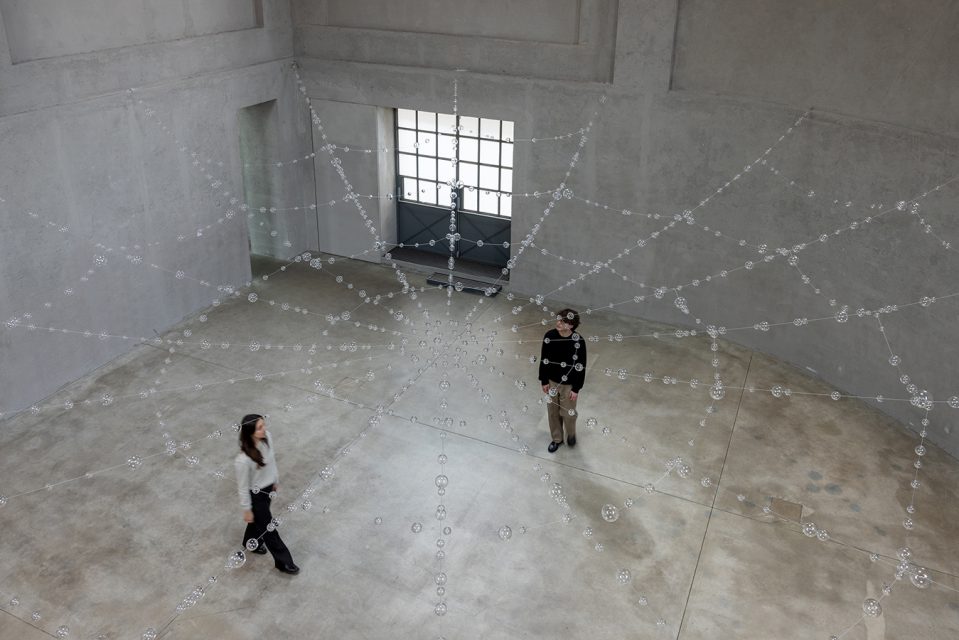
Four cities, 27 days, hundreds of shows, countless events. During the fashion month, we are submerged in a flood of information where substance drowns, the worthwhile and irrelevant dissolve in the same tide. In the midst of this well-organized chaos, I had only one escape: Fondazione Prada. This calm heaven in the south of Milan is more than an architectural hors d’oeuvre, the art foundation founded in 1995 by Miuccia Prada and her husband Patrizio Bertelli is one of the leading artistic institutions of the city. Although constantly impressed by the innovative projects presented, this time Mona Hatoum’s work resonated differently with me.
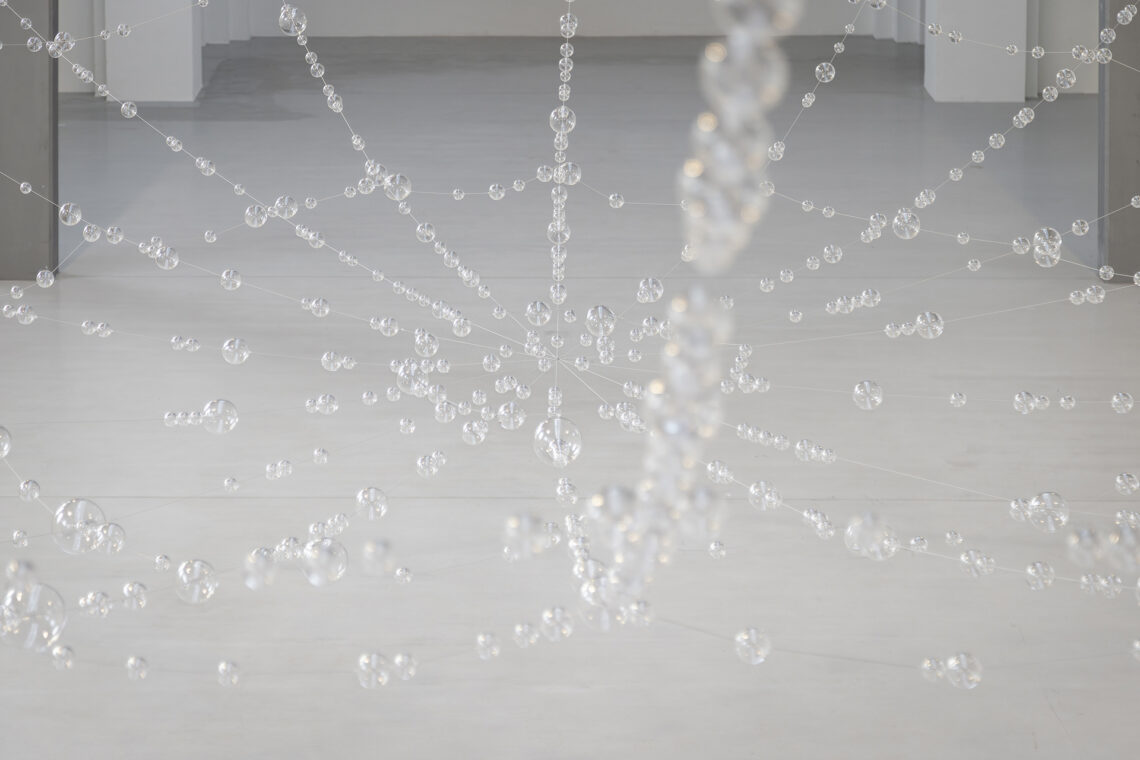
The exhibition is “Over, Under and In between” by Mona Hatoum where she exhibits three immersive artworks. The name is very descriptive: the web comes over us, threatening and fascinating, the map scattered under us underlines our world’s instability, and the Grid lives in the “in between”, a liminal space erected as a symbol of resilience.
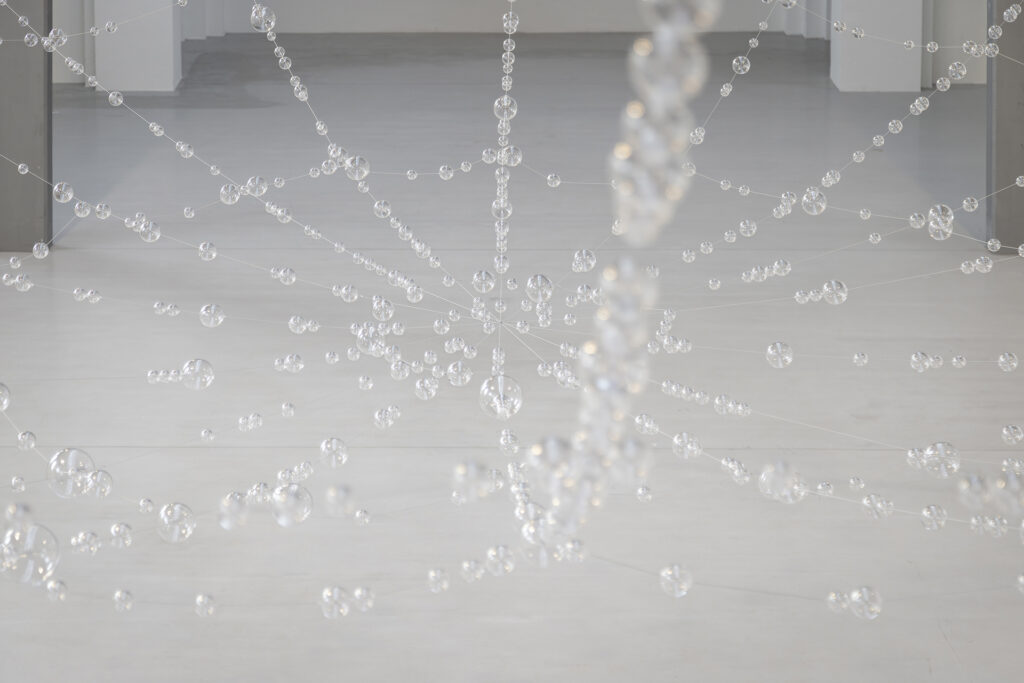
As spectators, we step in the exhibition thrown under a spider web. The body reaction is immediate: paralyzed yet star-struck, we become the prey of a giant creature. The unsettling distance with the work creates simultaneously intimacy and fear. In this closeness, our gaze loses itself in the intricacies of the woven constellation while connecting us with Fondazione Prada’s Cisterna building. The work is a visual threshold where the web generates space, forcing an encounter between the spectator/actor, the building, and the work.
…fashion provokes it
We can easily connect this particularity ability to Holler’s Synchro Synstem presented in the same place. Holler made here a masterpiece of relational art, movement centered theoretically and practically around the whole of human relations and their social context. For Nicolas Bourriaudwho gave the movement’s definition, with relational aesthetic art is no longer an independent and private space. But if art lies in our relation with the work, if the experience matters, then why do we need to keep clothes untouchable, in their own space, to endorse them of aura in the Benjamin sense?
Well, we don’t .
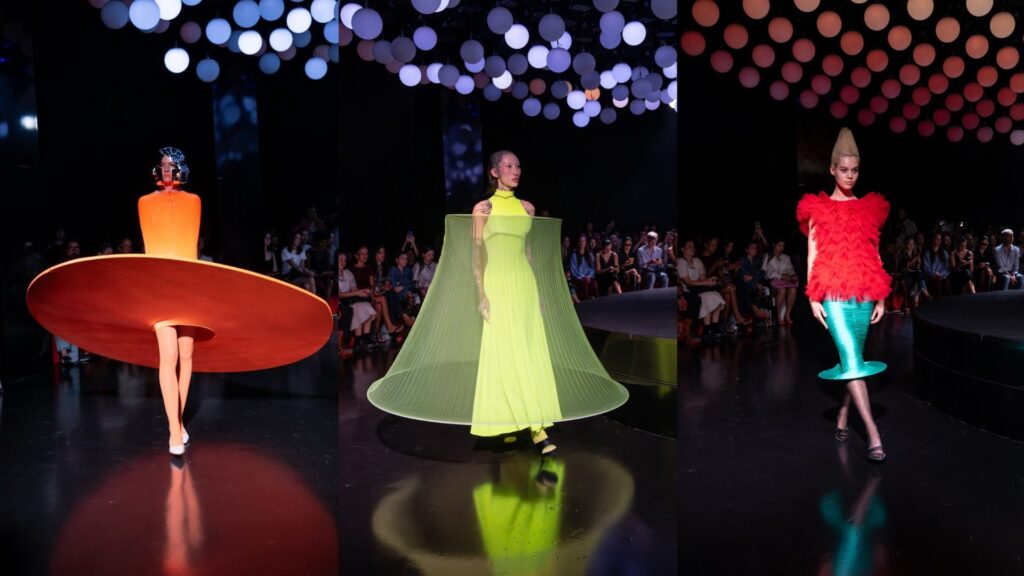
Therence Zhou’s work at Bad Binch TongTong proved it to us this NYFW. For him fashion is not a space of contemplation nor pure technical precision. The spectator needs to feel again, to be physically involved. Just like Hatoum, this comes through an appropriation of the spectator’s space. His clothes are sculptural, in the primary sense of the word, they occupy the space around the body and the spectator.
While the entrance in the Hatoum’s exhibitions conditions the work’s perception, Bad Binch TongTong equally decided to shake our perspective. In an Instagram post entitled “ We destroyed our show”, the director describes how he stripped out the guests of their usual comfort passing through Marina Abramovíc’s Snow/Windy/Spring on Planet Z . The giant grass installation questions our perception of space and rejects our anthropic point of view. Constrained in a corridor, this is a first violation of our own space perception, making us more sensitive to the clothe’s sculpturality.
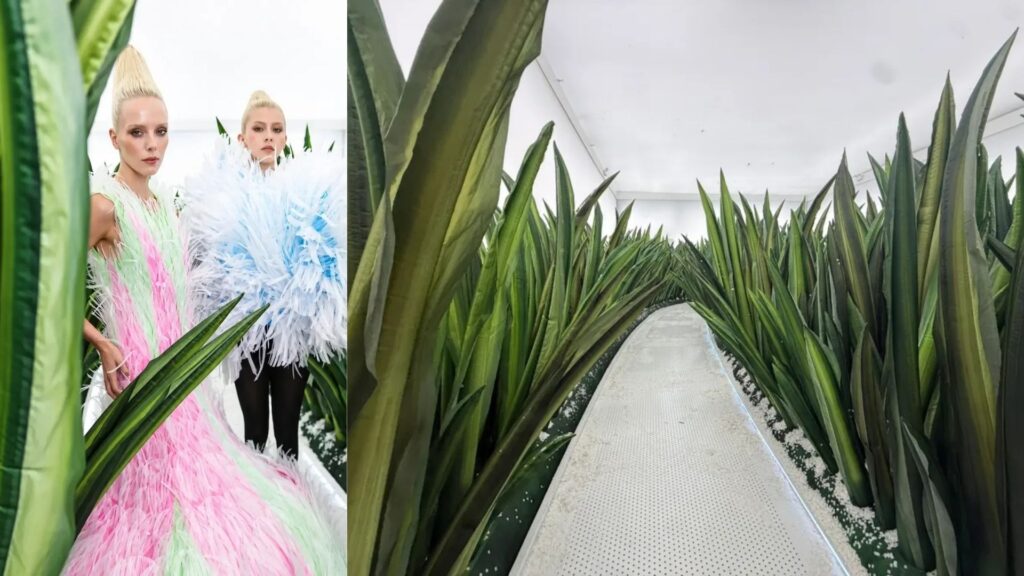
With Therence Zhou, clothes are not evolving in a neutral space, they break our imaginary spatial boundaries. This relation to clothe’s space is even further developed presenting them in giant eggs. Physically inaccessible, sight blurred, the egg shield fails at its protection roles and reveals clothes’ weaknesses, an alienation from the human. The clothes become a space of their own, an entity in themselves no longer relying on our admiration.
Discomfort, unsettlement: the art of disrupting.
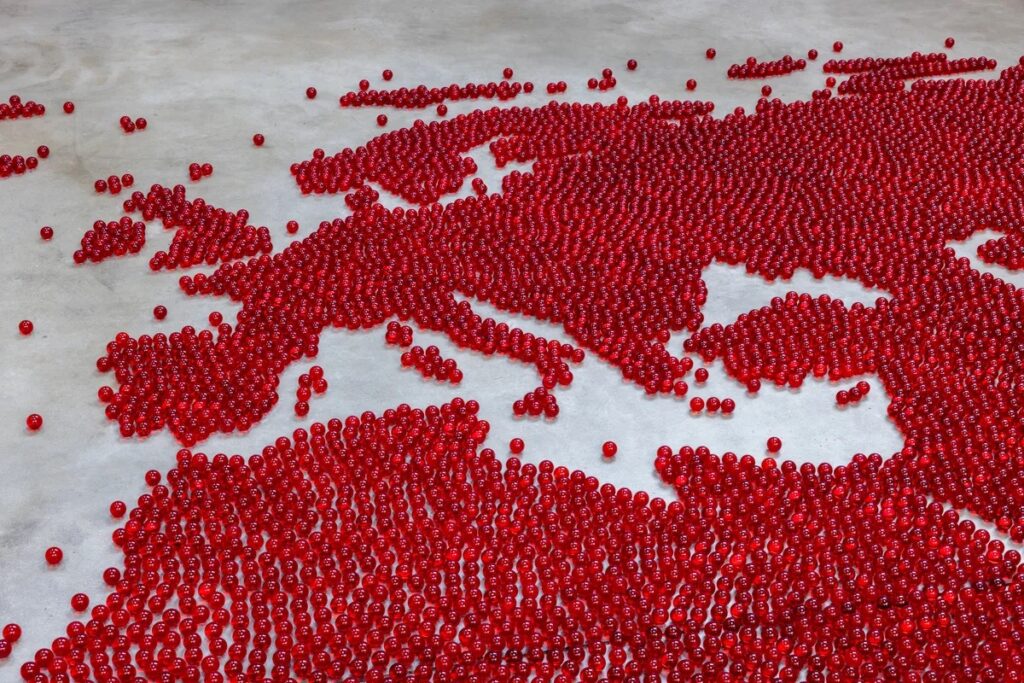
Moving to the second room of Hatoum’s exhibition, we end up upon a map made of red marbles. The work seems fragile, unstable, and slightly odd. Indeed the projection used isn’t the Mercator one, image our eye is used to, but a projection like Gall Peter’s that preserve the relative size of countries. In this very accurate world representation, it is our disturbed European eye that is questioned. We are forced to realize that we have distorted history and maps for the sake of our European ego and comfort.
With this in mind I could’t stop of thinking of fashion’s coverage taboo: 4 fashion week cities, 4 western viewpoints. Designers bring to each show, each city, their own stories and cultural background. Joe Salinas’ SS27 collection brought to Milan the “retablo”,a traditional object from the Andes in which small wooden figures encapsulate entire worlds and stories. Just like a retablo, a runway is a confined space that can present entire worlds and stories. But in looking for the essence of a cultural expression as Joe Salinas perfectly did, which fashion standards do we apply “modernity” to as opposed to traditional wear, Westerns?
In the map Mona Hatoum also develops her particularly rich semiology: each sign is dual, and interpretation personal. The red color could stand for love but it is also the blood of border conflicts, a tragedy who’s futility is underlined by the absence of borders in the work. The spider web arises fear, an experience of monstrosity, but it is also an experience of contemplative beauty under the woven constellation.
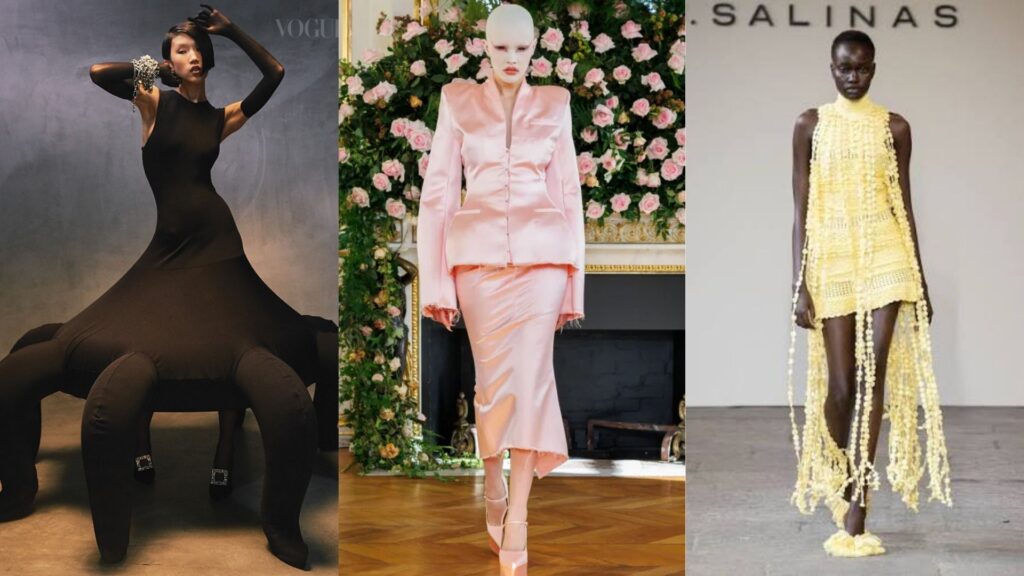
Fashion equally develops its own semiology. In SS23, Bad Binch TongTong indeed used his playful style to create monstrous creatures, further questioning our own reaction to the collection: are we repelled? amused? certainly both.
Another rich semiology is Matière Fécale’s, the new press favorite, playing with the duality of classical signs. It claims to be a radical, almost revolutionary brands, but it is polished with pastel, pinks and tulles in The Guilted Age. Their Madame H jacket also stands in the direct lineage of the Dior Bar Jacket. But passionate about distortion, they transformed this symbol of french elitism into the flag of their revolution.
A Performance of Art
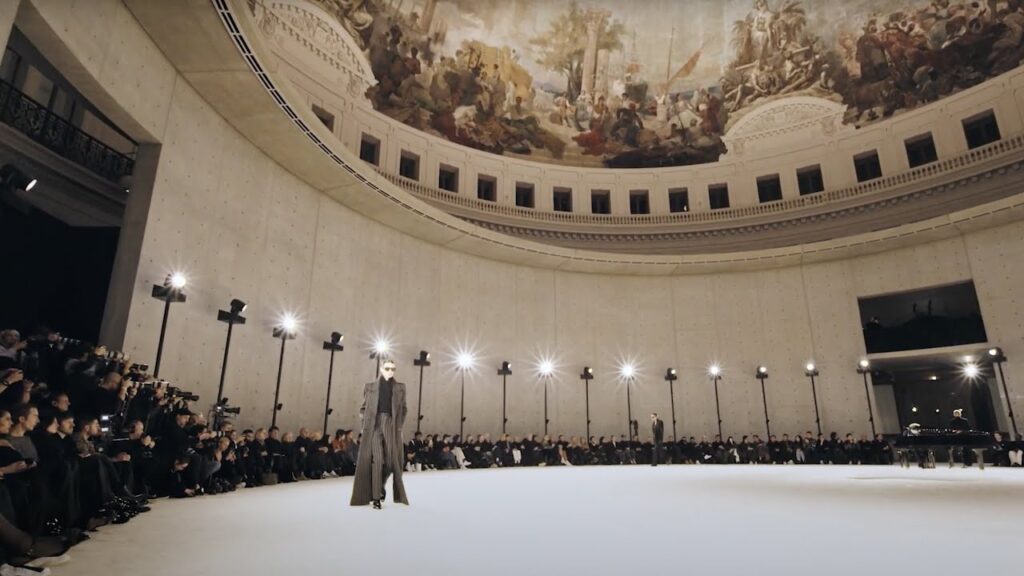
In this way, strolling through Mona Hatoum’s work made me reflect on shows which were really “art” as they didn’t insensibly mimic tools of authority: they rather proposed a fresh and innovative position that unsettled the guests. Wether through the space disruption, cultural clashes, or iconography reversal. What luxury houses forgot is that art is not a product but a posture. And aiming at artifying their products, big fashion corporation will end up mimicking the empty corpse of the artworld: interested in its marketing , its representation not its essence.
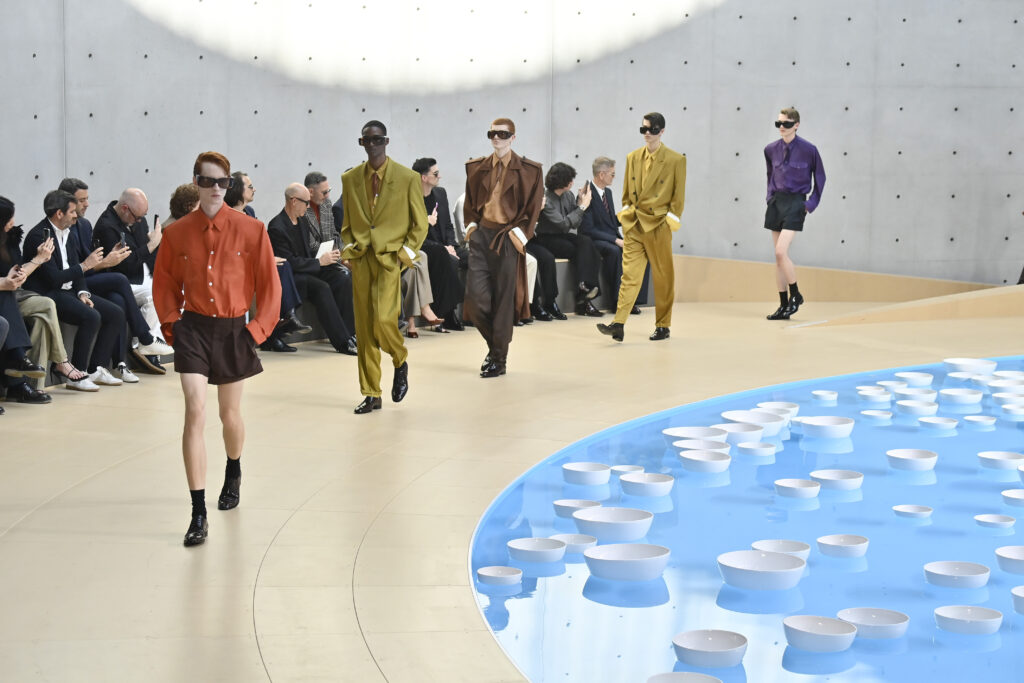
Let’s not be defeatists, some shows still bring together great sales, neat execution, beauty, and artistic posture. A prime example being Miuccia Prada and Raf Simons’ study of the skirt in their SS27 show. The apparent beauty is paired with an amazing research on the cultural, historic, and political role of the garment ( look up our show’s review on Instagram).
But not everything has to be art. And sometimes trying not to be is the key for an artistic approach. Demna decided to set his last show in a store, reconnecting with the primary role of fashion institutions: sell clothes. With this bold statement piercing through the show’s illusion of art, the designer adopts a posture closer to an artist than a designer blindly following this artification trend led by big corporations.
conclusion
Fashion sometimes plays hard to get: it seduces us, cultivates an air of artistic brilliance, and keeps us at a distance to make itself more desirable. Hatoum’s practice invited me to look again: at how an object occupies space, unsettles a body, or challenges a familiar code. Perhaps fashion’s artistic potential begins with this willingness to disturb its own image. Otherwise, beneath the spectacle and borrowed prestige, we risk finding precisely what Shakespeare’s title promises: much ado about nothing.
by Louis Pringault